When Race Becomes “Party”: The Redistricting Trick Targeting Black Voters
- Post by: Michael R. Bailey
- May 15, 2026
- No Comment
There is an old trick in American politics: when the law finally makes it harder to discriminate by race, change the language.
Do not say, “We are targeting Black voters.”
Say, “We are targeting Democrats.”
Do not say, “We are weakening Black political power.”
Say, “We are maximizing partisan advantage.”
Do not say, “We are dismantling majority-Black districts.”
Say, “We are correcting unconstitutional racial gerrymanders.”
That is the legal shell game now unfolding across the South. And if Black voters do not understand the trick, we will wake up one morning and wonder how our communities are still full of voters but empty of power.
The Supreme Court’s decision in Louisiana v. Callais narrowed the protection of Section 2 of the Voting Rights Act by making it harder to defend districts drawn to give Black voters a fair opportunity to elect candidates of their choice. The legal trap is simple: if race and party overlap, lawmakers can claim they are only targeting party. A Congressional Research Service summary explains that challengers now face a higher burden when trying to prove racial vote dilution, especially when states argue politics, not race, explains the map. (Every CRS Report)
That sounds technical.
It is not.
Imagine a restaurant owner says, “I don’t refuse service to Black people. I only refuse service to people wearing blue shirts.” But he knows every Black customer who comes in from the church convention is wearing a blue shirt. The result is the same. Black people are kept out. The excuse just changed.
That is what is happening with redistricting.
In the Deep South, Black voters are the backbone of the Democratic vote. So when Republican mapmakers say they are targeting Democrats, they are often targeting the political power Black voters have built through the Democratic Party. They may not say the word “Black.” They do not have to. The map says it for them.
Louisiana is the clearest example.
After years of litigation, Louisiana had a congressional map that included two majority-Black districts in a state where Black residents make up roughly one-third of the population. One of those districts helped elect Congressman Cleo Fields. Now, after the Supreme Court ruling, Louisiana Republicans advanced a new map that would eliminate one of those majority-Black districts and likely leave the state with five Republican seats and one Democratic seat. Reuters reported the Louisiana Senate passed that map 27-10 along party lines. (Reuters)
Republicans will tell you this is partisan.
But what does that mean when the “partisan” voters being cracked, packed, and moved are Black voters?
It means race is still in the room. It is just wearing a partisan mask.
South Carolina is walking down the same road.
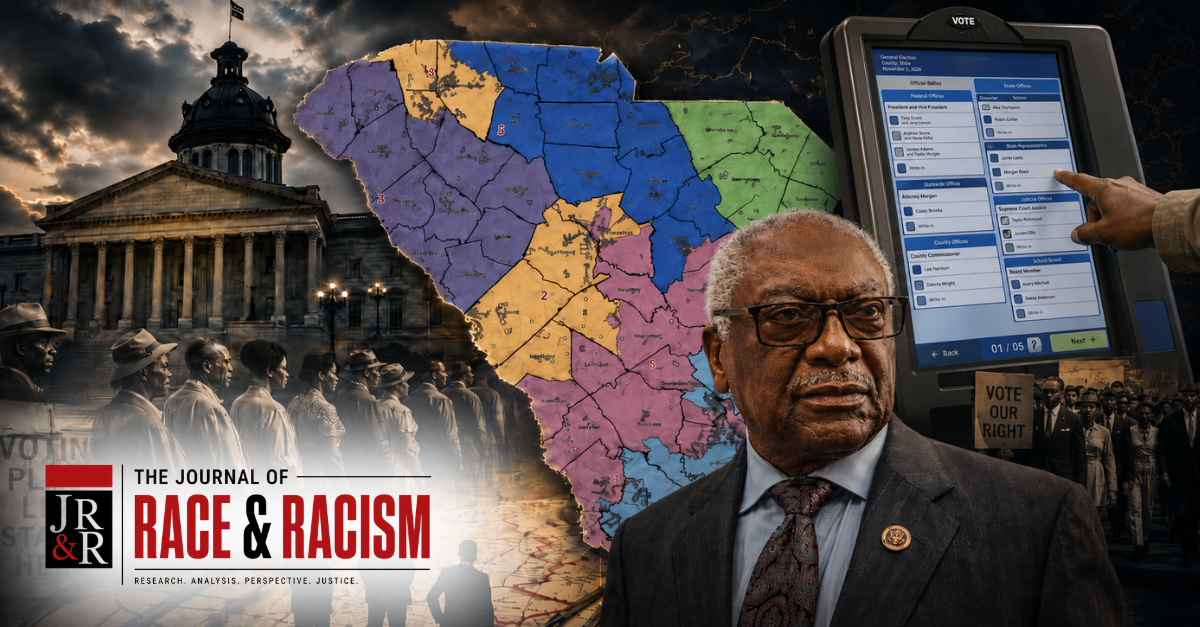
The proposed South Carolina map is aimed at turning a state delegation that is currently six Republicans and one Democrat into a possible seven-Republican sweep. The target is the Sixth Congressional District, represented by Jim Clyburn, the only Democrat in South Carolina’s congressional delegation and one of the most significant Black political figures in the country. WIS reported that the proposed map would reshape communities across Richland, Charleston, Orangeburg, and other counties, weakening the current Democratic and Black voting strength of the Sixth District. (https://www.wistv.com)
But this cannot be reduced to “saving Clyburn.”
This is bigger than one man.
This is about whether Black voters in Orangeburg, Richland, Columbia, Charleston, Hampton, Allendale, and rural South Carolina can still convert their numbers into representation.
That is what redistricting decides.
Before you ever cast a ballot, the map may already decide whether your vote has power.
Think about school zoning. If a school board does not want certain children in a high-performing school, it can redraw the attendance lines. Nobody has to say they are targeting those children. They just move the lines around their neighborhoods.
Think about a bank loan. If a lender says, “We do not deny Black applicants; we deny applicants from certain zip codes,” but those zip codes are historically Black communities, the discrimination did not disappear. It got dressed up in different paperwork.
That is the same trick here.
Redistricting is paperwork with power.
It determines who gets heard, who gets ignored, who gets represented, and who gets reduced to a minority inside someone else’s district.
This is why the phrase “partisan gerrymandering” can be misleading in Southern politics. It makes the issue sound like a normal fight between Democrats and Republicans. But when Black voters are overwhelmingly packed into one party because the other party has spent decades attacking their voting rights, their history, their schools, their books, their DEI programs, and their civil rights protections, then attacking that party’s voters has racial consequences.
You cannot spend sixty years making Black voters politically homeless in the Republican Party, then act innocent when you target Democratic voters and hit Black communities first.
That is not coincidence.
That is strategy.
And let us be clear: Republicans are not hiding the partisan goal. AP reported that Louisiana Republican Sen. Jay Morris said the maps are drawn to maximize Republican advantage for incumbent Republicans. (AP News)
At least that part is honest.
But honesty about partisan intent does not erase racial impact.
If I swing a bat at your mailbox because I do not like your house number, the mailbox is still broken. My excuse does not repair the damage.
The damage here is Black political power.
The danger is that courts may now accept the excuse while ignoring the damage.
That is why Black voters, Black media, Black churches, civil rights groups, and grassroots organizations must stop treating redistricting like boring government math. These maps are not lines. They are weapons. They decide whether our communities speak with a full voice or get scattered into political silence.
The trick is simple.
They are turning race into party.
Then they are using party to dilute race.
And if we do not call it what it is, they will redraw our power in plain sight and tell us it was never about us.
This is a developing story. As South Carolina’s redistricting fight continues and more details emerge, this article will be updated with new information, legal developments, and community impact.